Medicare for All: Can Hospitals Afford the Payment Rates?

Public concern about rising health care costs—particularly hospital costs—remains a major issue for patients, employers, insurers, and policymakers. In the recent election, approximately six in ten voters reportedly expressed concerns about health care affordability. Several candidates have proposed versions of “Medicare for All.” Although such proposals may appeal to those seeking more affordable coverage, their implications for hospital finances warrant careful examination. One important consideration is the level of payment hospitals receive from government programs, particularly Medicare and Medicaid.
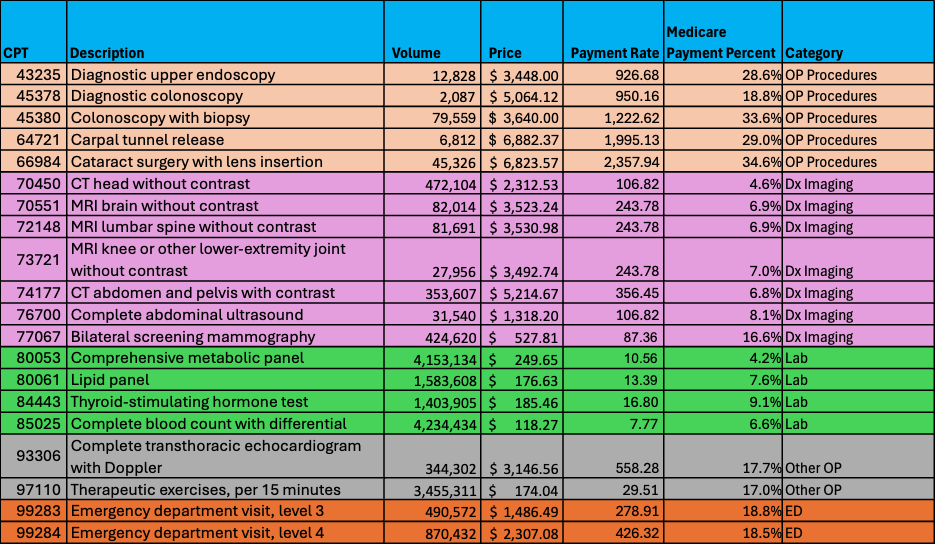
To examine Medicare payment levels across selected hospital services, we identified 20 frequently used hospital CPT codes. These codes were grouped into five categories: outpatient procedures, diagnostic imaging, laboratory services, emergency services, and other services. We then analyzed first-quarter 2026 data from the Chronic Conditions Warehouse (CCW) Virtual Research Data Center (VRDC) to assess service volume and Medicare payments for these codes.
For the 20 selected CPT codes, we used applicable Medicare national payment rates, based on outpatient payment classifications or fee schedules, to calculate payments as a percentage of hospital charges. These comparisons describe the relationship between Medicare payment rates and charges; they do not, by themselves, establish the relationship between payments and the costs of furnishing each service.
The analysis indicates that Medicare payment rates represent a relatively small percentage of hospital charges for the selected services. The lowest average payment-to-charge percentages were observed in two traditional ancillary service areas: diagnostic imaging (8.1%) and laboratory services (6.9%). The diagnostic imaging average would have been lower without CPT 77067 (bilateral screening mammography). Outpatient procedures had the highest average payment-to-charge percentage, at 28.6%. These results highlight substantial differences between Medicare payments and hospital charges. Whether the payments are below the actual costs of providing these services requires additional cost data. Similarly, the extent to which lower government payments contribute to higher commercial prices is an important question, but it cannot be established from payment-to-charge ratios alone.
Why are payment-to-charge percentages especially low for imaging and laboratory services? One possible explanation is the competitive environment in which these services are provided, including the presence of freestanding imaging centers and laboratories. However, differences in hospital charges, Medicare rate-setting methods, service mix, and site-of-service requirements may also contribute to the observed ratios. Hospitals may face “readiness to serve” costs that freestanding facilities do not incur to the same degree. For example, an MRI performed on a scheduled outpatient basis may require different staffing and operational resources from an MRI performed in connection with an emergency trauma case, even when the same CPT code is reported. Likewise, hospital laboratory testing may involve urgent turnaround requirements rather than routine batch processing. These differences merit consideration when comparing payment adequacy across settings.
Government programs operate within finite budgets and must balance health care spending against other public priorities. Nevertheless, proposals to extend Medicare-based payment rates to a much larger share of hospital services raise important questions about financial sustainability, particularly for hospitals with limited operating margins or substantial emergency and standby capacity. Depending on how a Medicare for All program is designed and financed, hospitals could face pressure to reduce costs, modify services, or, in some cases, close facilities. The potential consequences for quality of care and access deserve careful evaluation before assuming that Medicare payment rates can be broadly extended without significant effects on hospital operations.
Have thoughts or questions?
Related