Emergency Department Wait Times and Coding Intensity Are Rising: Are the Two Connected?
Introduction
A recent Wall Street Journal article highlights the growing problem of emergency department overcrowding and extended waiting periods. In his November 6, 2026, article, Peter Loftus describes how patients who require inpatient admission are increasingly spending many hours, and sometimes more than a day, waiting in emergency departments for a hospital bed.
The article reports that approximately one in four patients admitted through emergency departments waited at least four hours for an inpatient bed in September 2024, compared with approximately one in eight in September 2017. The proportion waiting 24 hours or longer tripled over the same period. More recent data from Vizient indicate that median boarding times reached five hours during April through June 2026, an increase of 25% over the prior year.
These findings raise important questions about hospital capacity, patient access, and the quality of emergency care. To see whether these changes coincide with shifts in the intensity of emergency department services, we reviewed Medicare emergency department utilization from 2017 through 2025 using data from the Chronic Conditions Warehouse Virtual Research Data Center.
Changes in Emergency Department Coding Patterns
Hospital emergency department facility services are generally reported using five E/M CPT codes, ranging from 99281 through 99285. These codes reflect increasing levels of facility resources associated with providing emergency department services. Hospitals typically establish their own facility coding guidelines, subject to applicable payer and regulatory requirements. The guidelines are intended to reflect differences in the resources consumed in treating patients. An examination of coding frequencies over the past decade reveals a substantial shift toward higher-level services as seen below.
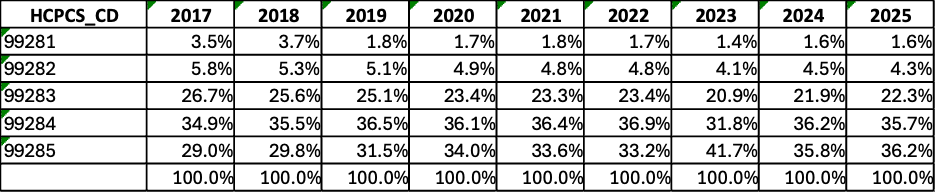
The percentage of visits assigned to CPT code 99285 increased by 7.3 percentage points between 2017 and 2025, representing a relative increase of approximately 25.1%. The combined percentage of visits assigned to the two highest levels, CPT codes 99284 and 99285, increased from 63.9% in 2017 to 71.9% in 2025. The increasing concentration of visits at the highest service levels suggests a meaningful change in reported emergency department resource intensity.
Are Emergency Department Patients Becoming More Complex?
One possible explanation for the shift toward higher-level codes is that emergency departments are treating patients with increasingly complex medical conditions. The aging of the population, the increasing prevalence of chronic diseases, and the movement of less serious conditions to urgent care centers and other outpatient settings could result in a greater concentration of patients requiring intensive emergency department services.
The Wall Street Journal’s findings are consistent with growing pressure on hospitals to accommodate patients requiring inpatient care. Longer inpatient stays, staffing shortages, and difficulties transferring patients to rehabilitation or other post-acute settings can reduce the availability of hospital beds and contribute to emergency department boarding.
However, longer boarding times do not necessarily mean that the emergency department services provided to individual patients have become more resource-intensive. A patient may spend many additional hours waiting for an inpatient bed without requiring additional diagnostic testing, treatment, or other resources that would justify a higher facility E/M code. However, the hospital may incur additional staffing and monitoring costs that might justify higher E/M codes.
Conclusion
Emergency departments are facing increasing pressure from both operational and financial perspectives. Recent reporting in the Wall Street Journal documents substantial increases in the time patients wait for inpatient hospital beds after emergency department evaluation. Meanwhile, an analysis of emergency department coding frequencies from 2017 through 2025 reveals a significant shift toward higher-level E/M codes. The percentage of emergency department visits assigned to CPT code 99285 increased from approximately 29% to 36%, while the combined percentage assigned to the two highest levels increased from approximately 64% to 72%. This shift to higher E/M codes may be the result of longer wait times for patients scheduled for an inpatient bed. The increased cost associated with longer wait times will then add to the total cost of treatment and might also have a negative effect on the quality of care.
Have thoughts or questions?
Related